
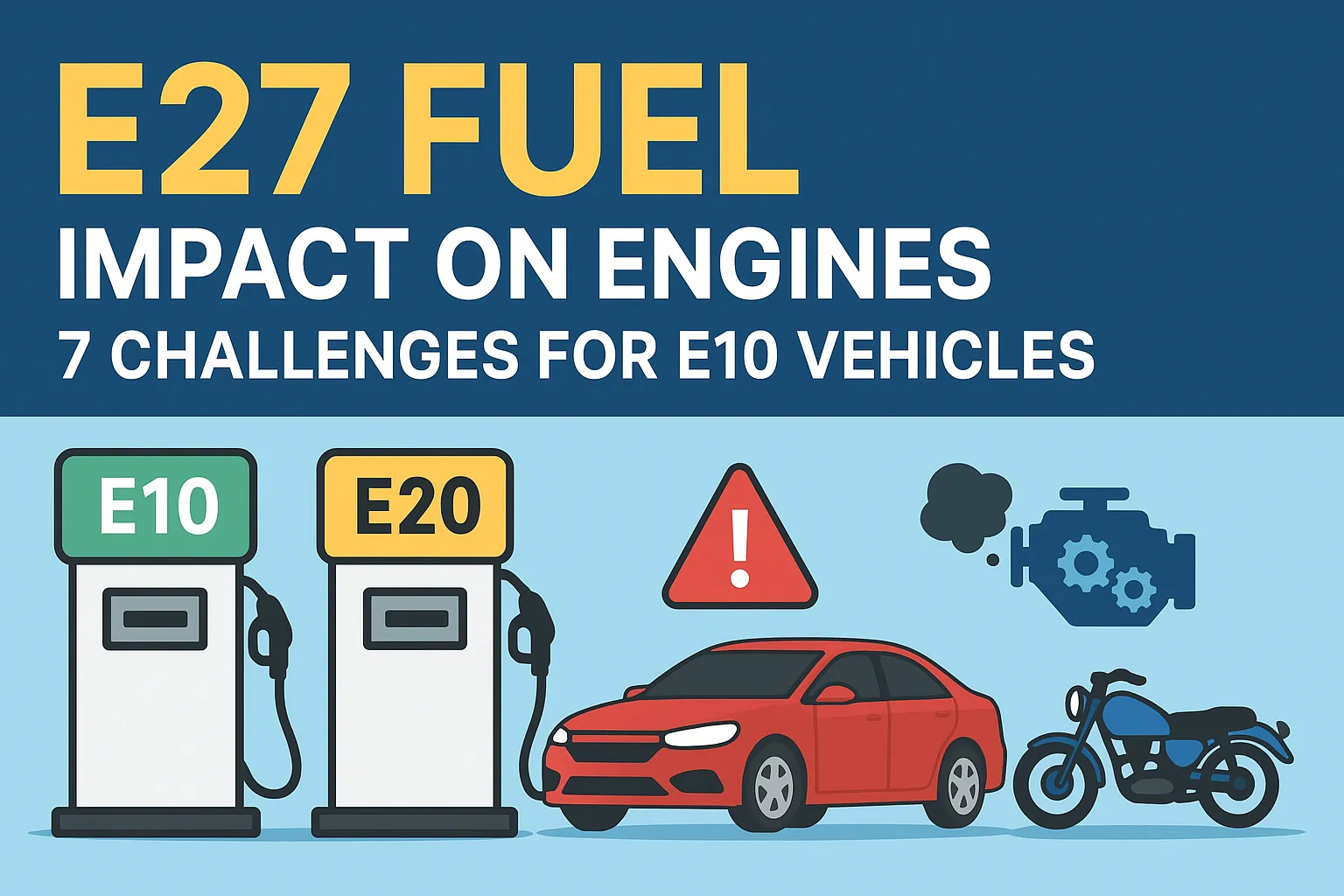
Introduction: The E20 Buzz in India
India’s fuel ecosystem is undergoing a massive shift with the government’s push towards ethanol blending in petrol. From April 2023, petrol with 20% ethanol blend (E20) has been introduced in select regions, with plans for pan-India rollout by 2025. While this is a positive step toward reducing oil imports and cutting emissions, questions remain about how this transition affects vehicles designed for E10 compliance.
The E20 fuel impact on engines—especially those of older cars and bikes—has become a subject of debate. Can E10 vehicles safely run on E20? What are the real risks and benefits? Let’s dive deep into the implications.
Comparison Table: E10 vs E20 Fuel Effects on Cars & Bikes
| Feature / Parameter | E10 Fuel (10% Ethanol) | E20 Fuel (20% Ethanol) | E20 Fuel Impact on Engines (Key Notes) |
|---|---|---|---|
| Fuel Composition | 10% ethanol + 90% petrol | 20% ethanol + 80% petrol | Higher ethanol increases corrosiveness and water absorption |
| Energy Density / Mileage | Standard petrol-equivalent | Slightly lower (5–7% drop in mileage) | E10 cars/bikes experience reduced driving range |
| Engine Compatibility | Most modern engines compatible | Only E20-ready engines recommended | E10 engines may see rough idling and reduced performance |
| Fuel System Wear | Minimal effect on fuel lines, gaskets, injectors | Higher risk of corrosion, rubber and metal wear | Long-term use in E10 engines may shorten engine life |
| Emission Profile | Moderate reduction in emissions | Better CO2 reduction, but may increase NOx/CO in non-compatible engines | E20 helps reduce greenhouse gases in compatible vehicles |
| Warranty / OEM Guidance | Fully covered | Only covered if engine is E20-ready | E10-only vehicles risk voiding warranty if damaged |
| Maintenance Frequency | Standard servicing intervals | May require more frequent servicing | Fuel pump cleaning, injector checks, and filter replacement recommended |
| Safety Concerns | Low | Slightly higher due to ethanol’s corrosive nature | Leakage risk and overheating possible in older vehicles |
| Vehicle Examples | Pre-2020 cars, older bikes | Post-2020 cars, post-2021 bikes |
1. Understanding E10 vs. E20 Fuel
-
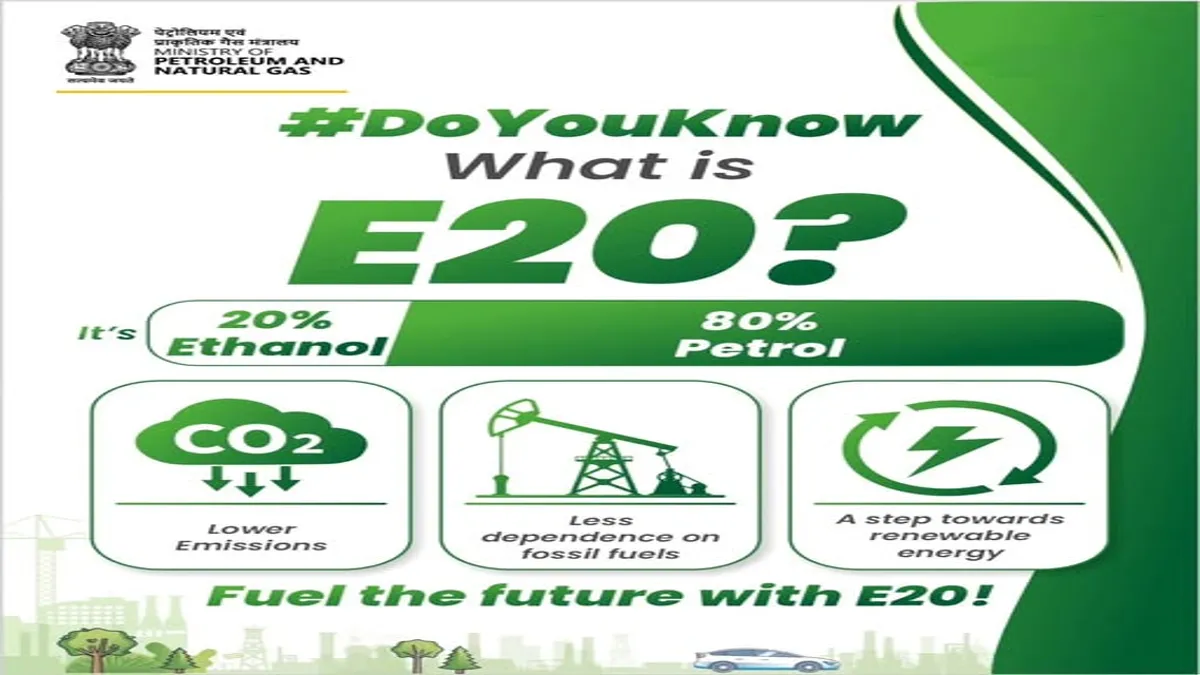
E10 fuel = 10% ethanol + 90% petrol.
-
E20 fuel = 20% ethanol + 80% petrol.
Ethanol is a renewable biofuel, but it has different chemical properties compared to petrol:
-
Lower energy density (less mileage per litre).
-
Higher corrosiveness.
-
More hygroscopic (absorbs water easily).
This means E20 fuel impact on engines can vary significantly based on whether the vehicle is E10-ready or specifically built for E20.
2. Performance Issues: Mileage & Power Drop
The most immediate and visible effect of using E20 fuel in E10-compliant engines is a drop in fuel efficiency. Studies suggest mileage can drop 5–7% due to ethanol’s lower energy content.
E20 Fuel Impact on Engines:
-
Cars: Owners may notice reduced driving range, especially on highways.
-
Bikes: Commuters who depend on mileage may see a sharper impact.
In addition, ethanol burns differently than petrol, sometimes causing rough idling or slightly reduced power output.
3. Engine Longevity Concerns
Ethanol is more corrosive than petrol. When E20 runs in E10 engines:
-
Rubber seals, gaskets, and hoses may degrade faster.
-
Metal components like fuel tanks and injectors risk corrosion and rusting.
-
Carbureted bikes (still common in smaller towns) face greater risk than modern fuel-injected systems.
Over time, these issues can shorten engine life if preventive maintenance isn’t done.
4. Compatibility Issues: Warranties and OEM Guidance
Most manufacturers in India have issued advisories, E20 Fuel Impact on Engines.
-
Cars post-2020 (especially Maruti Suzuki, Hyundai, Tata, Honda) are being upgraded for E20 compatibility.
-
Two-wheelers post-2021 from Hero, Bajaj, Honda, and TVS are E20-ready.
But for vehicles older than this, warranty coverage may be void if damage occurs due to E20 usage. This adds financial risk for owners.
5. Maintenance Costs Go Up
Running E20 in E10 engines could mean:
-
Frequent servicing (fuel pump cleaning, injector checks).
-
Replacement of fuel lines or rubber parts sooner than expected.
-
Higher likelihood of check-engine lights due to altered combustion.
While these may not show up immediately, long-term use of E20 increases ownership costs.
6. Emission Benefits vs. Engine Stress
On the positive side, E20 fuel has environmental advantages:
-
Reduces greenhouse gas emissions by up to 10%.
-
Supports India’s target of blending 20% ethanol by 2025 to cut oil imports.
However, in engines not designed for it, incomplete combustion can actually increase emissions of carbon monoxide (CO) and nitrogen oxides (NOx). So, the green benefit depends heavily on engine compatibility.
7. Safety Concerns for Older Vehicles
Another overlooked angle of the E20 fuel impact on engines is safety. Ethanol’s corrosive nature may weaken fuel tanks and lines, increasing risks of leakage. In motorcycles, prolonged E20 use in older engines might cause overheating or engine knock.
8. Industry Transition: A Mixed Bag
Automakers are rapidly making their fleets E20-ready. But India’s huge population of older two-wheelers and cars—many still running on E10 designs—poses a challenge.
-
Urban areas: Likely to adapt faster with newer models.
-
Rural areas: Older bikes and cars will bear the brunt of E20 risks.
9. Solutions for Owners of E10 Vehicles
If you own an E10 vehicle, here’s what you can do:
-
Check manufacturer’s advisory: Some models can tolerate up to E20 with minor issues.
-
Regular servicing: Prevents ethanol-related deposits and corrosion.
-
Use additives: Fuel stabilizers can reduce water absorption.
-
Plan for upgrades: If your vehicle is older than 2017, consider shifting to E20-ready models in the next 2–3 years.
Conclusion: The Reality of the Transition
The shift to E20 fuel is a bold move for India’s sustainability goals. But the E20 fuel impact on engines of E10-compliant cars and bikes cannot be ignored. For older vehicles, risks include reduced mileage, higher maintenance, and potential long-term damage. For newer vehicles, the transition will be smoother, but owners should still expect a slight performance trade-off.
As the rollout continues, awareness and careful adaptation are key. E20 fuel brings environmental gains—but without proper engine readiness, it may prove costly for vehicle owners.
Also Read: https://grandautoworld.com/maruti-suzuki-retail-sales-crosses-80000/
FAQs on E20 Fuel Impact on Engines
1. Can E10-compliant cars run on E20 fuel?
Yes, most E10-compliant cars can technically run on E20 petrol, but it is not recommended for long-term use. E20 fuel impact on engines designed only for E10 may include reduced mileage, faster wear of rubber components, and higher maintenance needs. For detailed guidance, you can check SIAM’s advisory on ethanol-blended petrol.
2. Will E20 fuel damage older bikes and scooters?
Older two-wheelers (especially carbureted models) are more vulnerable. Continuous use of E20 in non-compatible bikes may lead to fuel system corrosion, reduced performance, and even engine knocking. Hero, Bajaj, and Honda have released advisories on E20-ready models—check directly with your manufacturer. Read more on MoRTH’s official ethanol-blending guidelines.
3. Does E20 petrol reduce mileage in cars?
Yes. Ethanol has lower energy density than petrol. Typically, mileage may drop by 5–7% when using E20 in E10 vehicles. While this helps reduce emissions, owners must factor in higher fuel consumption. A report by NITI Aayog confirms this performance trade-off.
4. Is E20 fuel better for the environment?
E20 reduces greenhouse gas emissions by up to 10% compared to pure petrol, making it more eco-friendly. However, if used in E10-only engines, incomplete combustion may cause higher carbon monoxide and NOx emissions. Learn more from MORTH’s ethanol blending program.
5. How do I know if my car or bike is E20 compatible?
Most vehicles manufactured after 2020 (cars) and 2021 (bikes) in India are E20-ready. You can check your owner’s manual or visit your brand’s official website for the list of E20-compatible models.
6. What precautions should I take if E20 is the only fuel available?
-
Use a good-quality fuel additive to minimize ethanol’s corrosive effects.
-
Ensure timely servicing of fuel pumps, injectors, and filters.
-
Avoid long-term storage of E20 in tanks as ethanol absorbs water.
-
Plan for an upgrade if your vehicle is older than 2017.
Also read: https://grandautoworld.com/hero-splendor-gst-price-cut/
1 thought on “E20 Fuel Impact on Engines: 7 Shocking Downsides for E10 Cars & Bikes”