

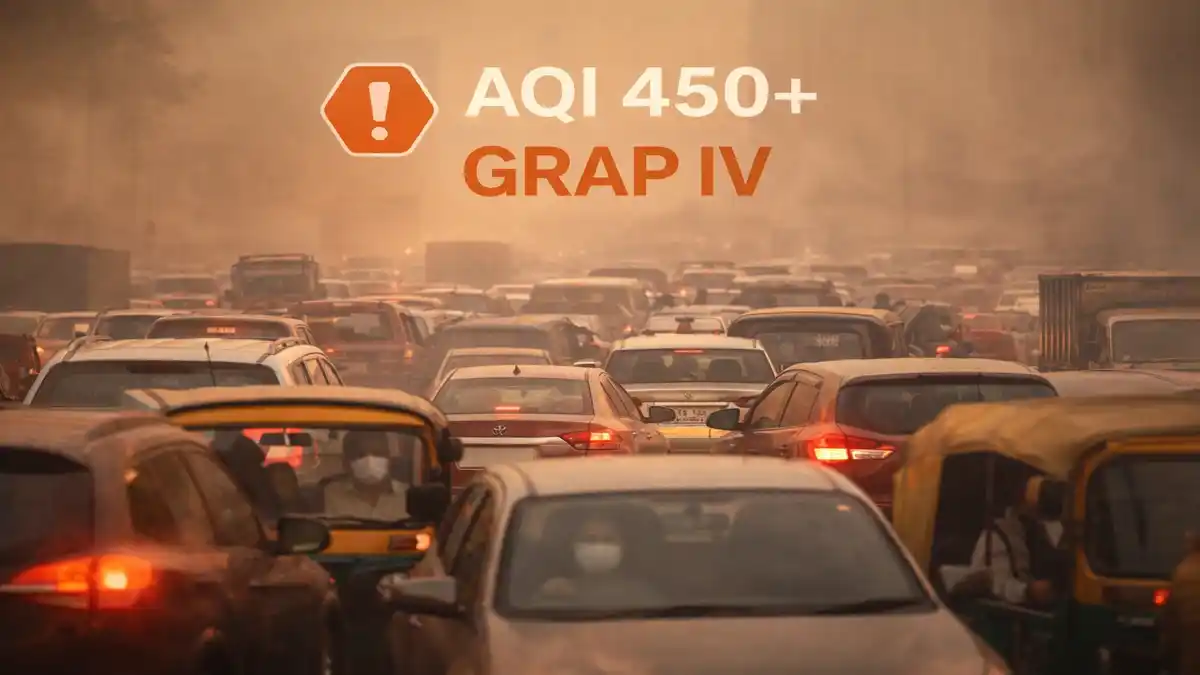
GRAP Stage 4 Guidelines: What It Means for Automobiles in Delhi & NCR (Exact Rules + Practical Guide)
Every winter, Delhi-NCR’s air quality can slide into a “health emergency” zone. That’s when GRAP (Graded Response Action Plan) kicks into higher stages—bringing sudden, real-world restrictions that can stop certain vehicles from entering Delhi, restrict older emission-standard cars from plying, and tighten enforcement at borders and on roads.
This guide explains Stage 4 (GRAP-IV / “Severe+”) with official, exact measures and—most importantly—what they mean for cars, trucks, taxis, fleet operators, and daily commuters.
Quick context: Stage-IV was invoked across NCR on 13 December 2025 when Delhi’s AQI crossed the ‘Severe+’ trigger (AQI > 450), and was later revoked when air improved. Press Information Bureau
What is GRAP Stage 4 Guidelines and when does it activate?
GRAP Stage-IV = “Severe+” and is triggered when Delhi’s air quality reaches AQI > 450 (as per the extant GRAP trigger used by CAQM).
Stage-IV actions come on top of Stage-I, II and III measures already in force, meaning restrictions stack up as pollution worsens.
The exact GRAP Stage 4 vehicle rules (official measures)
1) Truck entry into Delhi: BS-IV trucks stopped
Under Stage-IV, authorities stop entry of BS-IV truck traffic into Delhi, with a clear exception list:
-
Allowed: Trucks carrying essential commodities / essential services
-
Allowed: LNG/CNG/Electric trucks and BS-VI diesel trucks
What it means: If you’re running freight operations, Stage-IV can instantly disrupt supply chains unless your truck qualifies under the exemptions or cleaner fuel/BS-VI categories.
2) Delhi-registered diesel Heavy Goods Vehicles (HGVs): BS-IV and below banned
Stage-IV also mandates a strict ban on plying of:
-
Delhi-registered diesel HGVs (BS-IV and below) inside Delhi
-
Exception: Vehicles carrying essential commodities / essential services
What it means: This hits older heavy commercial fleets the hardest—especially local Delhi HGV operators—because it affects plying, not just entry.
Stage 4 also tightens restrictions that affect “automobile movement indirectly”
Even if your private car is compliant, Stage-IV often causes traffic patterns, office commuting and road activity to change because the same official order also flags additional emergency steps.
3) States may consider “emergency measures” like odd-even
CAQM’s Stage-IV action plan explicitly states that State Governments may consider additional emergency measures, including:
-
Odd-even basis for running of vehicles (by registration numbers)
-
Closure of colleges/educational institutions
-
Closure of non-emergency commercial activities
What it means: Even compliant cars can face restrictions if local authorities activate odd-even under Stage-IV conditions.
The most important “car owner” restriction often comes via Stage 3 (runs together with Stage 4)
When Stage-IV is active, Stage-III measures remain active too—and that’s where the big passenger car rule appears in official orders:
4) BS-III petrol & BS-IV diesel LMVs (4-wheelers) restricted
Under Stage-III, NCR states/GNCTD are directed to impose strict restrictions on plying of:
-
BS-III petrol LMVs (4-wheelers) and
-
BS-IV diesel LMVs (4-wheelers)
in Delhi and the districts of Gurugram, Faridabad, Ghaziabad, Gautam Buddha Nagar.
What it means for you (simple):
-
If your car is BS-III petrol → it can be restricted during GRAP-III/IV periods (especially in the listed districts).
-
If your car is BS-IV diesel → it can be restricted during GRAP-III/IV periods (especially in the listed districts).
-
BS-VI vehicles are generally the safest bet during GRAP peaks.
Practical checklist: How to know if you’ll be affected
Check 1: Your BS norm (fastest way)
-
Look at your RC, or use manufacturer/service records.
-
If it reads BS-III petrol or BS-IV diesel, be alert during GRAP-III/IV windows.
Check 2: Where you drive most
Even within NCR, restrictions are often enforced more strictly in:
-
Delhi borders (entry points)
-
Key districts named in orders (Gurugram, Faridabad, Ghaziabad, Gautam Buddha Nagar)
Check 3: You operate freight/commercial vehicles?
-
BS-IV trucks: can be stopped from entering Delhi (unless exempt)
-
Delhi diesel HGV BS-IV and below: can be banned from plying (unless exempt)
What counts as “essential services / essential commodities” for exemptions?
The Stage-IV order keeps the exemption wording broad—“essential commodities / essential services”—which typically includes critical supply and emergency functions (food, medical supplies, utilities, municipal services, etc.). However, the exact operational interpretation can vary by enforcement teams and local notifications.
If you’re a fleet operator, keep:
-
relevant delivery documentation
-
duty slips / authorisation letters
-
route plans and vehicle papers
ready for checkpoints.
Why this matters for Delhi-NCR motorists in 2026
GRAP is increasingly reactive + fast-moving: restrictions can be invoked, intensified, or revoked within days based on meteorology and AQI movement. In December 2025, Stage-IV was invoked at AQI Severe+ and later revoked when conditions improved—showing how quickly the “rulebook” can change.
For automobile users, the key takeaway is: your vehicle’s BS norm now directly affects where you can drive during peak pollution episodes.
FAQs: GRAP Stage 4 Guidelines
1) What AQI triggers GRAP Stage 4?
GRAP Stage-IV (“Severe+”) is invoked when Delhi’s AQI crosses 450 (AQI > 450).
2) Are all vehicles banned in GRAP Stage 4?
No. Stage-IV targets high-emission categories first—especially BS-IV truck entry into Delhi (with exemptions) and Delhi diesel HGVs (BS-IV and below). Passenger car restrictions often come via Stage-III (BS-III petrol & BS-IV diesel 4-wheelers in listed NCR areas).
3) Which trucks can enter Delhi during GRAP Stage 4?
During Stage-IV, LNG/CNG/Electric trucks and BS-VI diesel trucks are permitted, and essential commodity/service trucks are exempted—even as BS-IV trucks are stopped from entering Delhi.
4) Are BS-III petrol and BS-IV diesel cars restricted during GRAP 4?
Officially, that restriction is part of Stage-III, and Stage-IV runs in addition to Stage-III. So during GRAP-IV periods, Stage-III car restrictions can still apply in Delhi and specified NCR districts.
5) Can odd-even be implemented under GRAP Stage 4?
Yes—CAQM’s Stage-IV plan states that State Governments may consider emergency measures such as odd-even for vehicles.
Source: GRAP Stage 4 Guidelines
Also Read:
E20 Fuel Impact on Engines: 7 Shocking Downsides for E10 Cars & Bikes
Final word (GRAP Stage 4 Guidelines)
If you drive daily in Delhi-NCR, treat GRAP alerts like weather alerts. During GRAP Stage 4 Guidelines, the safest strategy is:
-
prefer BS-VI / CNG / EV for commuting
-
avoid driving restricted BS categories when GRAP-III/IV is active
-
keep documents ready if you qualify for essential exemptions (especially commercial vehicles)