

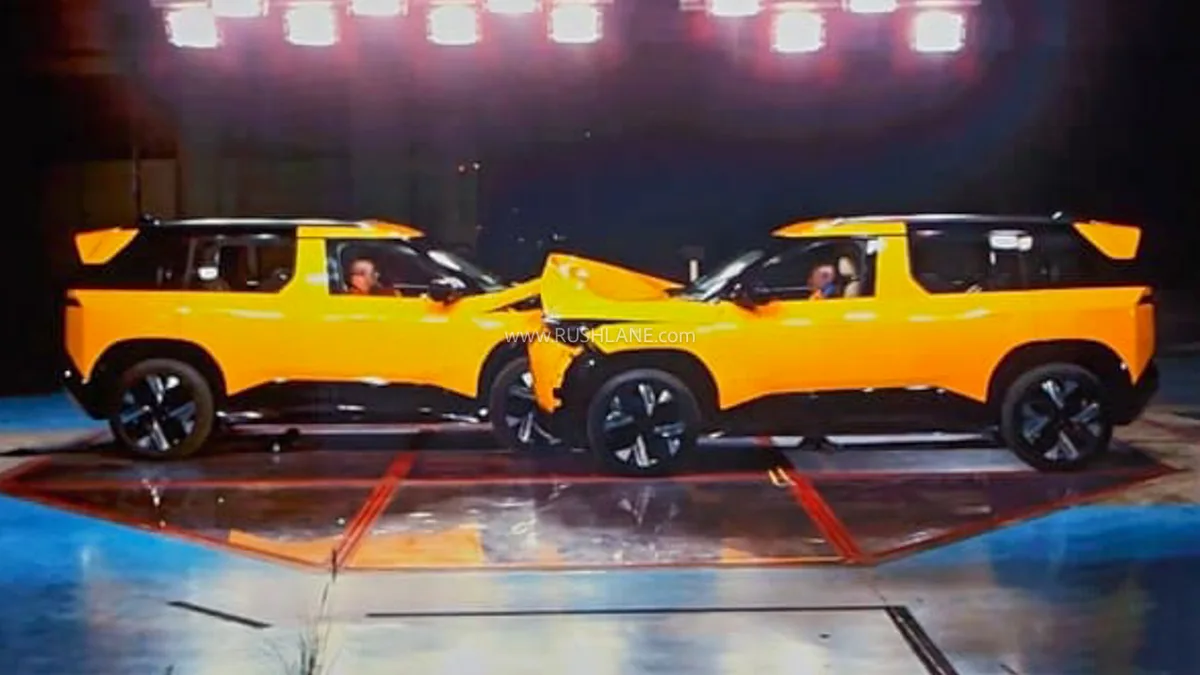
Tata Sierra Crash Test
In a pioneering move for Indian automotive safety, Tata Motors showcased Tata Sierra Crash Test with an internal car-to-car crash test involving two Sierra SUVs — a head-on collision that simulates real-world crash conditions more closely than the traditional barrier test. As reported, this is the first time an Indian automaker has publicly revealed such a test.
Why is this significant? Because most crash testing involves fixed barriers, not two moving cars. Tata’s decision to test two of its own vehicles crashing into each other raises the bar for safety realism. Let’s dive deeper into what the crash test revealed, its implications, and how it reflects Tata’s safety philosophy.
What Happened: Inside the Sierra Car-to-Car Crash Test
Tata Sierra Crash Test Reveals Head-On Car-to-Car Collision
-
At its launch event, Tata displayed footage of a controlled head-on crash between two identical Sierra SUVs.
-
This test was conducted internally by Tata Motors — not through a third-party safety body — which makes it a demonstration of their engineering confidence.
-
According to Tata, this kind of test is more realistic because it mirrors actual collisions on roads involving two moving vehicles, rather than static barrier impacts.
Key Results from the Crash Test
From the video and details revealed by Tata Sierra Crash Test:
-
Passenger Cell Integrity:
-
The cabin (passenger cell) remained largely intact, with no catastrophic deformation that reached critical safety zones.
-
Even the A-pillars (front structural pillars) did not appear to collapse under the force of collision.
-
-
Doors Functioning Post-Impact:
-
After the crash, the doors of both vehicles could be opened, which is a positive sign for occupant egress in a real accident.
-
-
Fuel System Sealed:
-
Importantly, the fuel system remained sealed, minimizing the risk of fuel leakage and fire after the collision — a critical safety concern in severe crashes.
-
-
Seatbelts Behavior:
-
The seatbelts in the test vehicles did their job — they remained secured during impact and released reliably afterward, ensuring occupant protection and the ability to exit.
-
-
Structural Strength:
-
Overall, Tata claims that the Sierra’s structure held up well: the strong architecture prevented excessive deformation.
-
Also Read:
New-Gen Tata Sierra Launched in India at ₹11.49 Lakh – Specs, Features & What You Get!!!
Safety Systems That Support the Structure
Tata hasn’t just relied on robust structure for Sierra’s safety — it has backed it up with a carefully thought-out suite of active and passive safety systems:
-
6 Airbags as standard.
-
Electronic Stability Program (ESP) and Traction Control System (TCS) help in preventing loss of control during slippery or difficult conditions.
-
Level-2 ADAS (Advanced Driver Assistance Systems): Over 20+ ADAS features like adaptive cruise control, lane-keeping, and more are expected in Sierra.
-
360° Cameras and Blind-Spot Monitoring: These help with visibility and crash avoidance, complementing the passive safety built into the vehicle.
Why This Crash Test Is a Big Deal for India
-
Real-World Relevance:
-
Unlike a barrier crash, a car-to-car crash test better represents how collisions happen on Indian roads — often with multiple moving vehicles.
-
-
Benchmark for OEMs:
-
By doing this publicly, Tata sets a new benchmark in the Indian auto industry. Other automakers may feel pressure to conduct similar internal tests or be more transparent about crash test results.
-
-
Safety Credibility:
-
Tata has historically emphasized safety (with many of its models scoring high in NCAP tests). Tata Group
-
Their crash facility in Pune has reportedly been in operation for decades, highlighting long-term commitment. Tata Motors
-
-
Consumer Confidence:
-
For prospective Sierra buyers, this test offers tangible proof of strong structural integrity — something that may influence safety-conscious customers.
-
Limitations & Things to Watch
While the Tata Sierra Crash Test is impressive, a few caveats apply:
-
Internal Testing, Not Independent Rating:
-
Unlike Bharat NCAP or Global NCAP tests, this was done by Tata itself. Without third-party certification, independent safety bodies’ rating is still awaited.
-
-
Not a Replacement for NCAP Tests:
-
Crash tests by NCAP assess various scenarios, side impacts, rollover, and more. This single head-on test is just one scenario.
-
-
Real-World Variability:
-
Even well-constructed tests can’t perfectly simulate real accidents where speeds, angles and vehicle loads vary widely.
-
-
Star Rating Pending:
-
As of now, no publicly disclosed Bharat NCAP (BNCAP) or Global NCAP rating for Sierra is available.
-
Once Sierra goes through BNCAP, its star rating will give a fuller picture of its crashworthiness.
-
Tata’s Long-Term Safety Philosophy
Tata Motors’ demonstration isn’t out of the blue. Safety has been deeply embedded in its DNA:
-
The company’s Integrated Safety Centre in Pune has carried out thousands of crash tests spanning internal combustion, EV and CNG vehicles. Tata Group
-
In its 2023–24 annual report, Tata reiterated that structural safety, advanced engineering and safety technologies are core to its vehicle development. Tata Motors
-
Tata’s past achievements in crash tests include landmark safety scores: for example, its Nexon earned a 5-star rating in Global NCAP tests. Global NCAP
Final Thoughts: What This Means for the Sierra & Indian Market
Tata Sierra Crash Test for the Sierra is a powerful safety statement — one that can redefine how Indian SUVs are perceived in terms of crash resilience. For buyers, this underscores:
-
A high level of confidence in the Sierra’s structural strength
-
Tata’s willingness to go beyond regulatory minimums to prove safety
-
The possibility that Sierra could receive a top-tier safety rating when tested by independent agencies
However, the ultimate test will be third-party safety ratings (like Bharat NCAP) and real-world crash data. Until then, Tata Sierra Crash Test remains a strong indicator, but not an official certification of crash safety.